
Mental and Physical Health Blog

Resilience, Flexibility, and Affect Regulation: Why Ego Strength Matters for Mental Health
Psychological resilience and flexibility are key indicators of emotional wellbeing and overall mental health. When people struggle to adapt to stress, fall apart easily, or become rigid in their thinking and behaviour, it may point to difficulties with what psychologists sometimes refer to as “ego strength.” Developing stronger emotional regulation skills can help people respond to life with greater calm, stability, and flexibility.

Signs of Mental Health: Realistic and Reliable Self-Esteem
Healthy self-esteem is not about feeling good about yourself all the time. It is about having a stable, balanced, and grounded sense of who you are. One that can hold both your strengths and your limitations without collapsing or becoming inflated.

Signs of Mental Health: Agency and Autonomy
Agency refers to your capacity to act with intention: to make decisions, initiate change, and influence the direction of your life. When this is present, you experience yourself as an active participant in your own life. When it is lacking, life can feel as though it is simply happening to you.

Signs of Mental Health: Personal Continuity — Who You Were, Who You Are
Personal continuity refers to your ability to experience yourself as the same person across time. That is, someone with a past, a present, and a future that all belong to you. When this sense is intact, you feel more grounded, coherent, and at ease within yourself.

Signs of Mental Health: Interpersonal Safety
Interpersonal safety is the foundation of mental health. It refers to a deep, often non-verbal sense of feeling safe in yourself, with others, and in the world. Without this, it becomes difficult to trust, to connect, and to rely on others for support.

10 Signs of Mental Health: A Deeper Perspective on Wellbeing
Mental health is not simply the absence of symptoms like anxiety or depression. It is better understood as a person’s overall capacity to live with a sense of meaning, connection, and self-understanding.

Bottom-Up Processing: Why Work With the Body in Trauma?
Bottom-up processing refers to body-based approaches to therapy that work directly with the nervous system and physiological experience of trauma.

Skills for Managing Hyperarousal and Hypoarousa
In my previous post on the window of tolerance, I outlined the basics of emotional regulation and how we move in and out of balanced states. Here, the focus is more practical. How can we recognise hyperarousal and hypoarousal, and what are some foundational ways to begin managing when things feel like too much or too little?
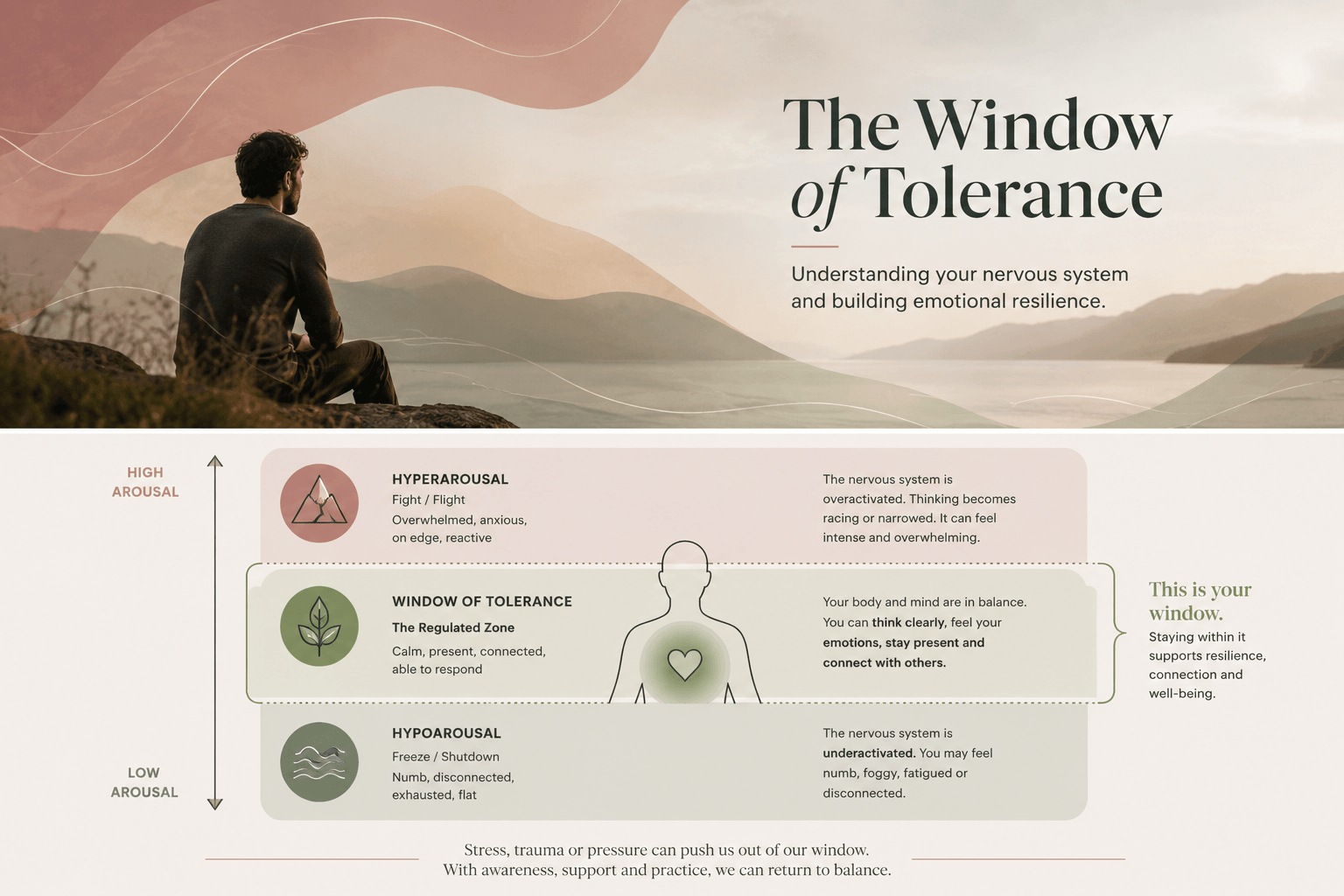
The Window of Tolerance: What is it?
The window of tolerance refers to the range of emotional and physiological states where you are able to function, feel connected, and respond to life in a manageable way.

What’s the difference between a psychologist and psychotherapist?
Choosing a therapist can be a confusing and overwhelming experience. If you’re thinking about reaching out for mental health support and beginning a professional therapeutic journey it can be hard to know where to start.

Getting started in psychotherapy: A guide for new clients
Psychotherapy remains a mysterious and daunting practice for many people. My hope here is to provide a short introduction of “need to know’s” so that you can make an informed decision and get the most out of therapy should you choose to do it.

Understanding Fibromyalgia, Warrnambool
People that live with Fibromyalgia know pain very well, they generally have a really high pain threshold and that’s because they’re in pain every single day.

Turning down the volume on the body’s alarm system: Chronic pain.
If you’ve had it more than six months, you fall into the chronic pain category and it can feel unpredictable, frustrating AND PAINFUL.

Feeling worthless? Try this.
From time to time we all experience the sense of being “not good enough”. You might doubt your capacity to achieve a certain goal, expect to be let down in relationship, or feel socially anxious, awkward or incapable.

2 types of depression (and what to do about them)
They say knowledge is power. If you’re suffering from depression, it might be useful to know what kind of depression you’re suffering from.

Jaw Pain Warrnambool: Causes, Risk Factors and Solutions
Jaw pain hurts. The jaw is the most used joint in the body. We are talking, eating, smiling, laughing, swallowing, this joint doesn’t get a lot of time to rest.

Foundations of Attachment Theory
The psychological theory of attachment refers to the emotional bonds which form between infant and caregiver during the first few years of life.

How technology affects the development of attention in children
The ability to pay attention and concentrate is a developmental achievement which requires certain environmental conditions.

Shadow work
Shadow work forces us to hold the tension of opposites - right and wrong, good and bad, light and dark.

Existential anxiety and “the courage to be”
We are vulnerable to sickness and death, we live with anxiety, we feel guilty for not living up to our potential, and we tend toward despair in tough times.