The Window of Tolerance: What is it?
The window of tolerance refers to the range of emotional and physiological states where you are able to function, feel connected, and respond to life in a manageable way. When you are within this window, you can think clearly, relate to others, and regulate your emotions. When you are pushed outside of it, these capacities begin to break down.
Understanding Arousal and the Nervous System
Our nervous systems naturally fluctuate throughout the day, moving between higher and lower states of arousal. These shifts are not only normal, but necessary.
Higher arousal supports activities that require energy and engagement, such as exercise, work tasks, or stimulating conversations. Lower arousal allows for rest and recovery, such as sleeping, listening to music, or quiet reflection.
In order to function well, we need access to both ends of this spectrum. Difficulties arise when arousal becomes too high or too low for too long, and we lose the ability to return to a balanced state.
The Window of Tolerance
When we feel relatively safe, secure, and connected to others, our arousal remains within what Daniel Siegel described as the window of tolerance.
Within this window, emotional experiences are tolerable. We are able to stay present, maintain perspective, and remain connected to ourselves and others, even when under stress.
Once we move outside of this window, however, our capacity to regulate begins to diminish.
Hyperarousal and Hypoarousal
When faced with threat or stress, the body naturally moves into states of survival.
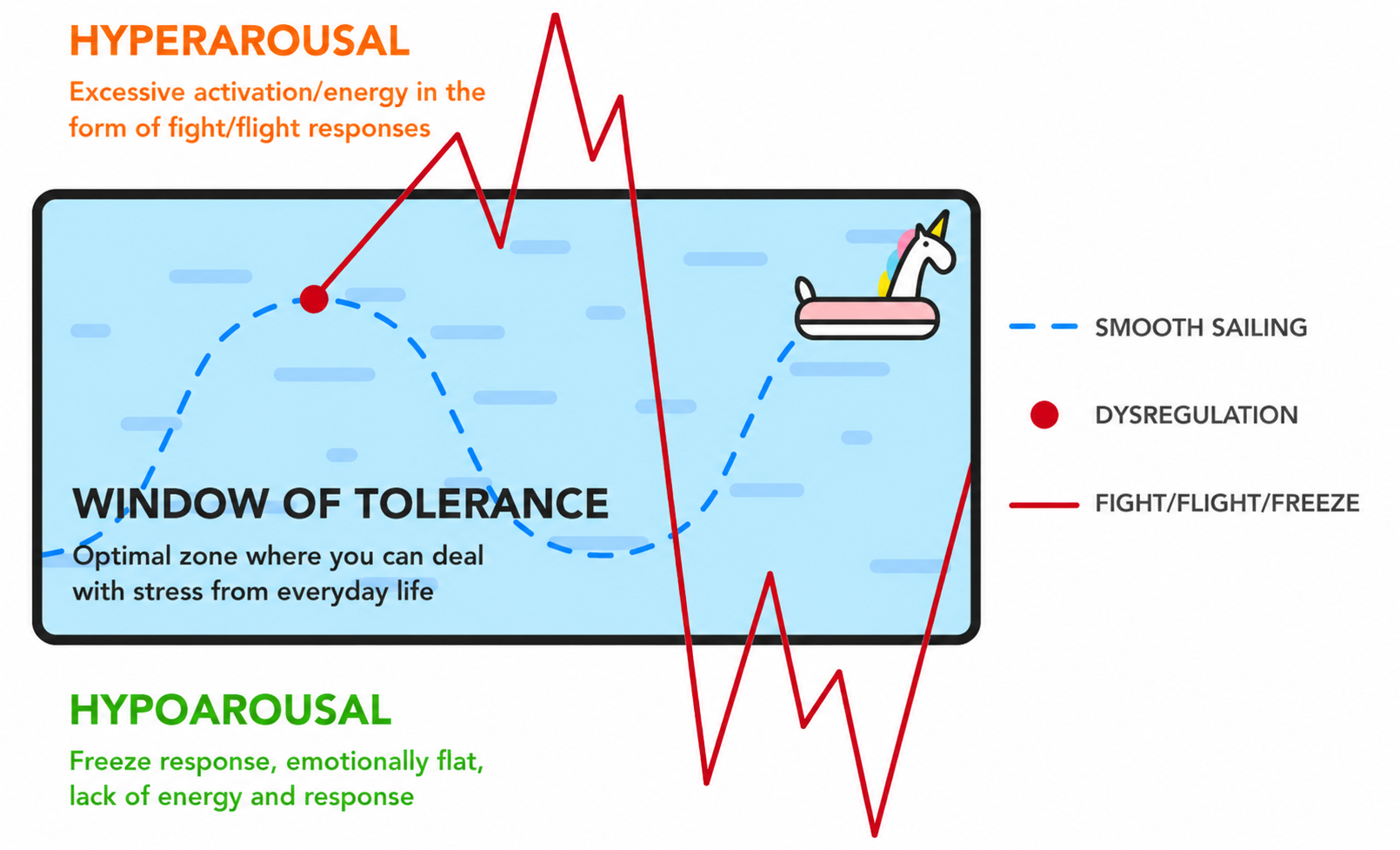
In hyperarousal, the nervous system becomes highly activated. This is often recognised as the fight or flight response. You may feel overwhelmed, on edge, or unable to settle.
If these responses are not effective, the system may shift in the opposite direction—into hypoarousal. This is a state of shutdown, where the body becomes still, numb, or disconnected.
These states are not signs of weakness. They reflect your nervous system’s automatic attempt to protect you.
The picture below shows a depiction of this:
Trauma and the Narrowing of the Window
From this perspective, trauma can be understood as an experience that overwhelms your capacity to stay within your window of tolerance.
Rather than being processed and integrated, the experience pushes the nervous system into extremes of activation or shutdown. In some cases, the body may enter a prolonged freeze response.
Over time, particularly in the context of chronic stress or interpersonal trauma, the nervous system can begin to expect danger. This is especially true when early relationships involved harm, unpredictability, or lack of safety.
The result is often a narrower window of tolerance, where even relatively minor stressors can lead to significant dysregulation. This may show up as ongoing hypervigilance, emotional reactivity, or periods of disconnection and numbness.
Organizations such as Blue Knot Foundation and Beyond Blue provide further information on how trauma affects the nervous system and emotional regulation.
Individual Differences in Regulation
People differ in their ability to tolerate and regulate stress. If you have experienced significant trauma, your window of tolerance is likely to be smaller.
This means that situations which may only mildly affect someone else can feel overwhelming or unmanageable for you.
This is not an indication that something is wrong with you. It reflects a nervous system that has adapted to environments where vigilance and protection were necessary.
Moving Toward Regulation
Understanding the window of tolerance can help you begin to recognise when you are moving outside of it.
You might notice moments of heightened anxiety, agitation, or urgency, or alternatively, a sense of shutting down, numbing, or disconnection. These shifts are cues from your nervous system about your current level of safety and stress.
With time and support, it is possible to develop a greater capacity to return to a regulated state. This may involve learning to identify triggers, building awareness of bodily signals, and gradually strengthening your ability to stay present during emotional experiences.
A Framework for Understanding Your Experience
The concept of the window of tolerance offers a way of making sense of your internal experience without judgement.
Rather than viewing these reactions as personal failings, it frames them as meaningful physiological responses shaped by your history and environment.
From this perspective, the focus shifts from “what’s wrong with me?” to understanding how your nervous system has learned to respond—and how it can, over time, learn something new.

Do you need mental health support in Warrnambool?
Start feeling like yourself again. Contact Us Today!
Book an Appointment
Do you need mental health support in Warrnambool?
Start feeling like yourself again. Contact Us Today!
Book an AppointmentAbout the author